

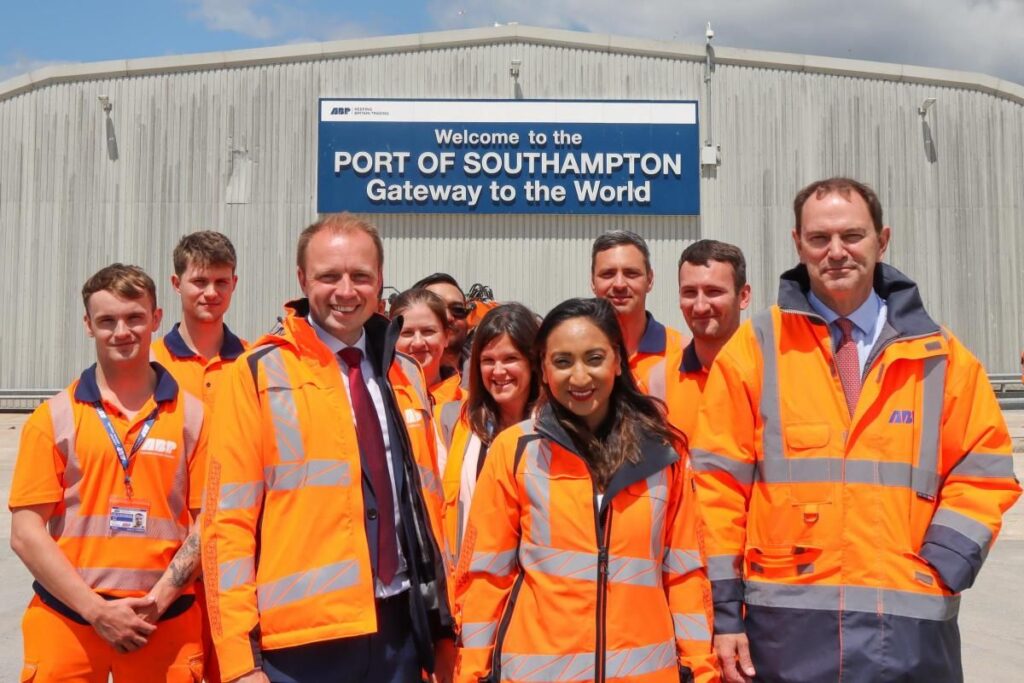
Before Christmas, I brought together the port, cruise operators and key maritime partners to coordinate a joint letter to Government, calling for urgent action to unlock the power infrastructure our city needs.
Our position was unambiguous: Right now, a lack of grid capacity is holding back shovel-ready investment, slowing port electrification and delaying projects that would cut emissions, improve air quality and bring hundreds of millions of pounds into Southampton.
If we unblock extra power, our port can speed up electrification, expand shore power, and lead the UK in maritime decarbonisation: creating good jobs, driving growth and protecting our environment at the same time.
I’m pleased to say that we have now received a response from Keir Mather MP, Minister for Aviation, Maritime and Decarbonisation, in which in he says that he recognises the importance of infrastructure improvements to Southampton’s ambitious plans for decarbonisation and says that he hopes to visit the city in the near future to continue these discussions. I’ll be doing everything I can to make sure this happens.
In the meantime, you can read the full response from the minister below.
Response from Keir Mather MP, Minister for Aviation, Maritime and Decarbonisation
12 January 2026
Dear all,
Thank you for your letter of 2 December, regarding the electrification and grid upgrades for the Port of Southampton, its users and the wider Southampton region. The Government recognises the importance of the Port of Southampton as a maritime gateway for UK trade and passenger transport.
Thank you for raising the important issues of bringing forward the upgrade of the Nursling Grid Supply point, reinforcing of the substation at Southampton Central and prioritising port electrification and shore power deployment.
Though I am sure you can appreciate I cannot make individual decisions on which grid infrastructure is upgraded – I want to reassure you I understand how significant these improvements would be to Southampton regarding its ambitions plans for maritime decarbonisation.
However, I wanted to reassure you that my department and the Government more widely is working with National Energy System Operator (NESO) and the Office of Gas and Electricity Markets (Ofgem) to implement reforms to the connections process. This includes taking action to strategically plan grid infrastructure upgrades, including through NESO’s work on transitional Regional Energy System Plans (tRESPs). The aim of the tRESP process is to inform anticipatory investment into the local distribution network between 2028 – 2033.
Whilst this does not guarantee that the Nursling Grid Supply Point and Southampton Central substation’s will be upgraded, I am pleased that NESO have identified ABP Southampton and the surrounding Solent Freeport as “a clear case for anticipatory investment”.
I would encourage the Port of Southampton to continue to engage with Scottish and Southern Electricity on their future energy demand and with the tRESP process.
On supporting faster development of alternative connection solutions, such as non-firm shore power solutions, I understand this is already something the local distribution network operators can offer. Government and Ofgem expect DNOs to provide high quality customer service and efficient, fit for purpose processes to enable quicker and more innovative connections and a customer-friendly connections process.
To ensure DNOs meet these expectations, Ofgem are currently undertaking an end-to-end review of the connections obligations and incentives pertaining to network companies. This is seeking to ensure timely delivery of connections and high levels of customer service. Ofgem have recently published a consultation/call forevidence on their updated proposals and next steps for the Review. This is open to industry feedback until 27 February 2026.
Regarding your request on cross government collaboration, I want to reassure you that we are already working closely with DESNZ, NESO and the network companies when it comes to transport electrification. Last year we ran a call for evidence on Net Zero Ports. This call for evidence covered the current and future energy demand at ports, as well as the challenges ports face in securing additional grid capacity.
This data will not only help us better understand how much energy ports need to decarbonise and grow but to champion their needs across government. I am grateful for ABP’s response to the Net Zero Ports call for evidence and providing useful data.
We continue to deliver on the commitments made in the Maritime Decarbonisation Strategy. In July 2026, the UK Emissions Trading Scheme will be extended to maritime, with full details set out in the UK ETS main Authority Response to the consultation, published on 25 November 2025, which outlines full details of the policy. We will continue to encourage the use of shore power through the decarbonisation goals in the Maritime Decarbonisation Strategy, and we will also consult on UK fuel regulations and continue to push for global action at the International Maritime Organization.
Last September, I was pleased to announce an additional £448m of Research and Development investment for the UK Shipping Office for Reducing Emissions (UK SHORE) programme. Through previous rounds of UK SHORE, we have already funded innovative clean maritime solutions to provide shore power via alternative connection solutions such as green hydrogen at the Port of Leith. Future rounds of funding will continue to support innovative clean maritime solutions.
Whilst I am afraid I cannot commit to a roundtable at this time, I do very much hope to visit the port of Southampton in the coming months and meet with many of you then. I know officials have recently met with staff from ABP to discuss shore power uptake and barriers and I am confident those conversations will continue.
Yours sincerely,
Keir Mather MP, Minister for Aviation, Maritime and Decarbonisation